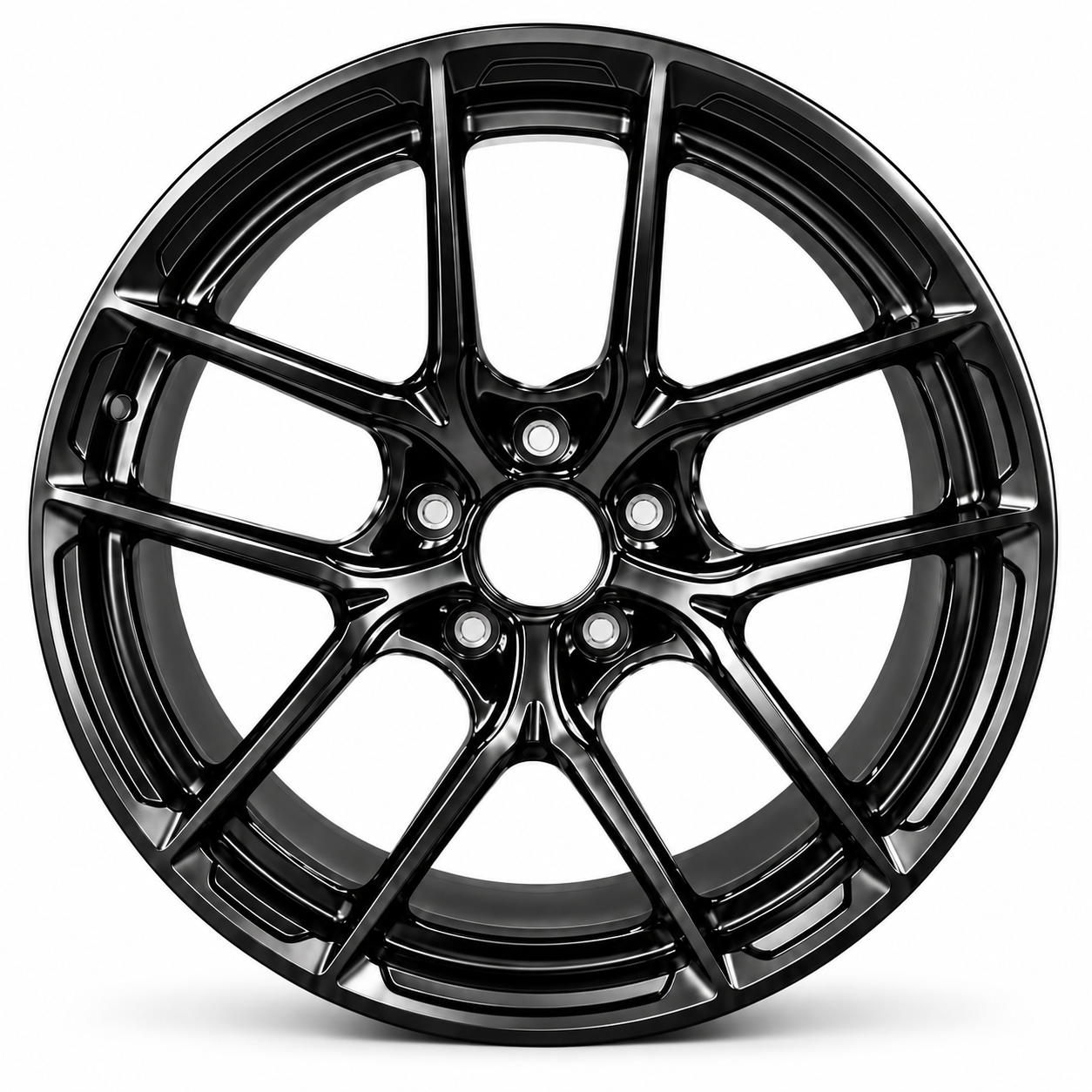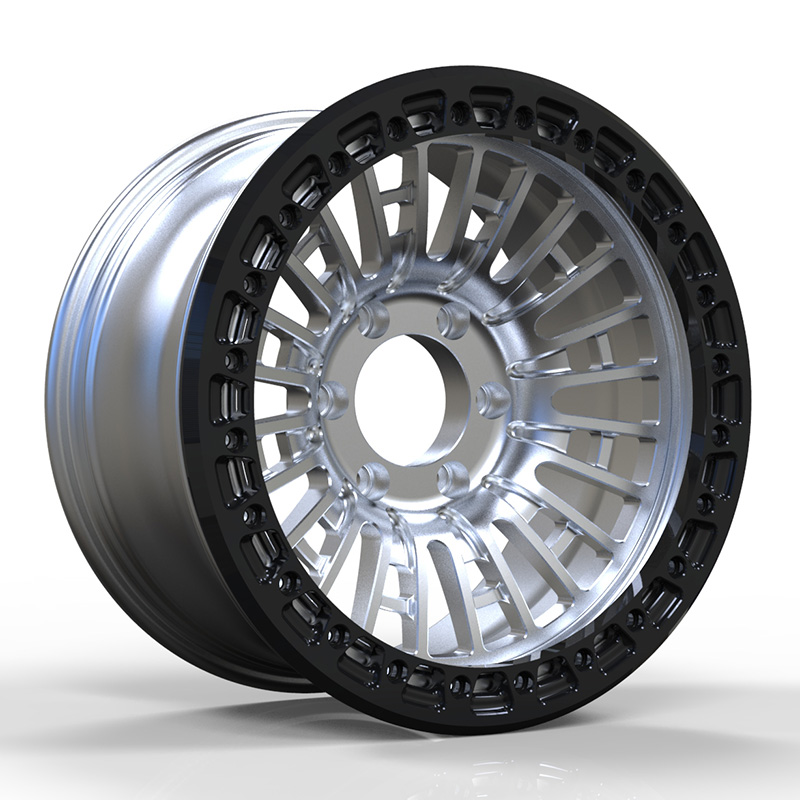
Concave forged wheels affect handling, but almost never because of the concave shape itself. What changes a car's behaviour is the four properties that come bundled with a new wheel: unsprung mass, rotational inertia, spoke stiffness, and offset. A well-specified forged concave wheel usually improves steering response and ride quality at the same time, because it reduces all four variables in the right direction. A badly specified one makes the car feel worse than the factory wheels it replaced, even though it is lighter — and the reason is almost always offset or mass distribution rather than depth.
This distinction matters commercially, because "do concave wheels ruin the ride" is one of the few questions that can kill a dealer's sale outright. The honest answer is that a forged wheel is a suspension component that happens to be circular. Change it and you change the way the tyre is loaded, the way the damper recovers, and the way the steering rack reads the road. Below, we break down each mechanism in the order a driver actually notices it, describe what a good forged specification does differently, and list the fitment decisions that quietly undo the benefit.
It is worth separating the look from the mechanics early. The SSD super concave range and a conventional flat-face forged wheel are made from the same materials on the same equipment; they differ in where the material sits. Concave geometry moves mass inward toward the hub and lengthens the spoke, which changes the load path but not the physics. What the driver feels is the net result of mass, stiffness, and geometry working together.
The Four Variables That Actually Change How a Car Drives
Unsprung mass is the weight that hangs below the spring: the wheel, the tyre, the brake disc, the caliper, and part of the suspension arm. Because it is not supported by the spring, it follows the road surface rather than the body, and every kilogram removed here changes how quickly the tyre can track a bump. Rotational inertia is the same mass spinning, and it resists acceleration and braking as well as changes in direction. Spoke stiffness decides how much the wheel deflects under cornering load before the tyre starts working. Offset decides where the contact patch sits relative to the steering axis, which governs straight-line stability and steering weight.
A forged wheel improves the first three by construction. Forging produces a stronger material per kilogram, so the designer can remove mass from the spoke and the barrel while keeping the wheel stiffer than the cast or flow-formed part it replaces. That is why a forged concave set can feel sharper in steering response and calmer over broken tarmac at the same time, which sounds contradictory until you remember that both effects come from the same cause: less unsprung mass and less deflection. Offset does not improve by itself. It only improves if the new wheel is machined to a backpad dimension that suits the vehicle, which is a deliberate specification decision rather than a property of the manufacturing method.
| Variable | What The Driver Notices | Better With A Forged Wheel? | Depends On Specification? |
|---|---|---|---|
| Unsprung mass | Tyre tracking over sharp bumps, cabin noise, impact harshness | Yes, directly, kilogram for kilogram | Diameter, width, and spoke count all change the saving |
| Rotational inertia | Throttle response, brake feel, initial turn-in crispness | Yes, and more than pure mass suggests | Moving mass inward matters as much as removing it |
| Spoke stiffness | Steering precision, mid-corner confidence, tyre wear pattern | Yes, forged material is stiffer at equal mass | Very deep concave needs a deliberate taper design |
| Offset and scrub radius | Tramlining, steering weight, torque steer, inner shoulder wear | Only if machined to the right backpad | Entirely a specification decision, not a materials one |
Why Deep Concave Can Feel Better or Worse Than Flat Face
Deep concave geometry concentrates spoke material closer to the hub, which reduces the polar moment about the wheel centre even before any weight is saved. That is why a deep concave forged wheel can sharpen throttle response noticeably on a rear-drive car: less inertia to accelerate, so the driveline has less to fight. It also pushes the load path outward along a longer spoke, which means the spoke has to be designed with a thicker root and a tapering section to avoid flexing under cornering load. When that is done properly, the wheel is stiffer than a flat-face design of the same weight. When it is done badly, the spoke flexes, the tyre's contact patch moves, and the driver reads it as vagueness on turn-in.
There is one place where concave geometry genuinely constrains the engineering: brake clearance. A deeper spoke face reduces the space between the spoke back and the caliper, so the designer has to either pull the hub face inward, thin the spoke in that region, or reduce the concave depth for that particular vehicle. Every one of those choices has a handling consequence, and this is precisely why a catalogue wheel that fits a whole model family rarely drives as well as a wheel machined for one application. A one-piece monoblock forged wheel designed around a specific brake package can carry both depth and stiffness, because the spoke profile is free to change inside the wheel without changing what the customer sees from outside.
Ride Quality Is Usually the Biggest Surprise
Most drivers expect a lighter wheel to improve steering and are surprised when it also improves ride. It does, for a simple reason: the damper no longer has to control as much unsprung mass, so it can follow the road instead of being overwhelmed by it. On a car with adaptive dampers the effect is larger still, because the control software sees a lighter corner and reacts faster. The one change that can make ride quality worse is diameter. Going up an inch while keeping the same overall tyre diameter means a shorter sidewall, and a shorter sidewall transmits more impact harshness regardless of how light the wheel is. If a customer's priority is comfort, a smaller-diameter forged concave wheel on a taller sidewall will feel better than a larger one, all else being equal.
There is a second, less obvious contributor to ride quality that buyers rarely consider: balance quality. A wheel that is in balance is not the same as a wheel that is round, and it is not the same as a wheel whose weight is evenly distributed around the rim. A forged wheel machined from a controlled blank tends to be more consistent in wall thickness than a cast one, which means less balance weight is needed and less corrective mass is bolted to the rim. That matters because balance weights are unsprung mass at the worst possible radius, and because a wheel that needs a large amount of correction is often a symptom of uneven material rather than of a manufacturing error at the final stage. Ask any supplier how much balance weight a typical wheel in your size requires; a confident answer in grams, rather than a shrug, is a good sign that the process is measured.
Tyre choice interacts with all of this, and it is worth flagging during specification because it is often the real cause of a complaint attributed to the wheel. A tyre with a stiff sidewall amplifies impact harshness and makes a deep concave wheel feel less compliant than it is, while a softer sidewall can make a very light wheel feel slightly slower to respond. Owners who fit a forged concave wheel on the original equipment tyre usually see the biggest improvement, because the wheel is lighter and the tyre was tuned around a heavier rim. Owners who change both at once and are then disappointed have usually moved to a tyre that trades comfort for grip, and no wheel specification can recover that.
Fitment Decisions That Undo a Good Wheel
In our experience, three fitment choices account for most complaints that are wrongly blamed on the wheel's construction. Each of them is easy to avoid if the specification is discussed before the order, and expensive to correct afterwards, because the wheel is already machined.
- Pushing the wheel outward to fill the arch. A small offset change feels dramatic in the showroom and shows up later as tramlining on a motorway and uneven inner shoulder wear.
- Adding a spacer to fix a clearance problem. Spacers move the load path further from the hub and multiply the bending moment on the bearing and the stud, which is a mechanical penalty rather than a cosmetic one.
- Skipping the alignment after fitting. New wheels rarely change the alignment itself, but they change how sensitive the car is to it, and an existing camber error that was tolerable before becomes obvious afterwards.
A pattern we see repeatedly with European distributors: the fitment is signed off on a stock car, then delivered on lowered cars, and the customer reports rubbing. The wheel is correct; the specification was made against the wrong suspension state. Always agree the ride height and camber at the sample stage, in writing.
How We Validate Handling-Critical Properties Before Shipment
A handling claim is only credible if it is backed by measurements. At our plant we verify the properties that produce the driver's impression, rather than relying on the impression itself. Dimensional checks confirm the backpad, hub bore, and bolt pattern against the approved drawing. Radial and cornering fatigue testing confirms the spoke survives repeated load cycles. Impact testing confirms the barrel and lip behaviour at the load points where most wheel failures actually happen. Air-tightness confirms the bead seat and, on multi-piece constructions, the joint. On top of our standard control plan we run additional thirty-degree and ninety-degree impact and deformation checks, because that is where the difference between a wheel that survives a pothole and one that does not tends to appear.
| Property | How It Is Checked | Handling Symptom If Wrong |
|---|---|---|
| Backpad and offset | Coordinate measurement against drawing | Tramlining, heavy or vague steering, inner shoulder wear |
| Balance and runout | Dynamic balancing, radial and lateral runout gauges | Vibration through the steering wheel at a specific speed |
| Spoke stiffness | Cornering fatigue rig, deflection measurement | Delayed turn-in, reduced mid-corner confidence |
| Bead seat seal | Air-tightness test at pressure | Slow pressure loss, uneven tyre wear, poor stability |
So, Do Concave Forged Wheels Affect Handling in Daily Driving?
The honest answer to do concave forged wheels affect handling, in the conditions most owners actually drive in, is yes, and the change is usually for the better. The clearest difference shows up on broken urban tarmac and motorway expansion joints, where a lighter wheel lets the damper control the corner instead of chasing it, which reduces the secondary bounce that makes a car feel unsettled. The second clearest shows up in steering response just off centre, where lower rotational inertia means the tyre reacts to a small input immediately rather than after a moment of hesitation. Neither effect is dramatic in isolation, but together they are the reason drivers describe a forged set as making the car feel smaller than it is.
The places where the answer turns negative are predictable. A deep concave wheel with a thin spoke section will flex under hard cornering loads, and the flex is felt as a delay in the steering rather than as a change in grip. An aggressive offset will make the car follow camber and lorry ruts in the road, which owners describe as the car having a mind of its own. A larger diameter with a shorter sidewall will transmit more impact energy into the cabin. Notice that none of these three failures comes from the concave shape or the forging process; all three come from specification choices made before the wheel was cut.
There is also a question of perception. Owners who have just spent money on wheels are inclined to notice every new noise and attribute it to the purchase. We ask dealers to run a simple before-and-after test that removes most of that bias: drive the same route, at the same speed, before fitting and after, and note three things only. Does the car track straight on a cambered road without correction? Does the steering wheel vibrate at a specific speed? Does the car settle after a sharp bump in one movement or two? Those three answers tell you almost everything about whether the new specification is right, and they take twenty minutes to collect.
It is worth saying plainly what does not change. A forged concave wheel does not lower the car, does not alter spring rates, and does not compensate for tired dampers or worn bushes. We regularly receive enquiries from owners who are trying to fix a vague front end by buying wheels, and the correct answer in those cases is to inspect the suspension first. Selling a wheel into that situation produces a dissatisfied customer and a complaint that the product was misrepresented, which costs far more than the order was worth.
- Measure first. Record the existing camber, toe, and ride height before anything is removed, so a later complaint can be compared against a baseline.
- Check the damper condition. A wheel cannot fix a worn shock absorber, and a customer told this before the sale rarely disputes the result afterwards.
- Balance on a calibrated machine. Note the balance weight used per wheel, because a sudden increase on one corner points at a clamp-on weight that has moved, not at the wheel itself.
- Torque to specification in the correct pattern. Uneven stud load is a common source of the vibration that gets blamed on the wheel.
- Re-check after a week. A brief settling period lets studs and bead seats stabilise, and a second torque check catches the rare case that needs corrective action.
What a Dealer Should Tell a Customer Before the Sale
Most handling complaints we see are not manufacturing problems; they are expectation problems that could have been resolved in a two-minute conversation at the counter. A customer who has been told that a forged concave wheel will make the car feel sharper and quieter over bumps will notice those effects and be satisfied. A customer who has been told nothing will notice only the one thing that changed for the worse, and that is the one thing they will tell their friends about. Setting expectations accurately is therefore not a courtesy; it is a returns strategy. If your team needs reference material, our technical knowledge library collects the same explanations in a form that can be shared with a customer directly.
We coach our distributors on four statements that should be made every time. First, steering response will improve measurably, most noticeably at low speed and on initial turn-in. Second, ride quality will usually improve over broken surfaces, but will feel firmer if the diameter has increased. Third, if the offset has moved outward, the car will follow road camber more strongly, and that is a deliberate trade against appearance. Fourth, the wheels must be torque-checked after the first week, because that single step prevents a category of complaints that no manufacturing improvement can eliminate.
Dealers who adopt this script consistently report fewer returns, and the reason is straightforward: when a customer is warned that something will change, the change becomes an expected feature of the upgrade rather than a defect. The same logic applies to load rating. If a customer plans to tow a trailer or routinely carries four adults in a large SUV, that should be established before the wheel is specified, because the correct answer at that point is a different construction rather than a different finish.
Finally, document it. A one-page handover note recording the specification, the torque figure, the inflation pressure, and the date of the first re-check protects both sides and takes five minutes to produce. In our experience, distributors who issue a handover note are the ones whose customers come back for the second set, and the second set is where this business is actually made. A forged concave wheel is a durable product, so the customer who buys once and never returns is a business model that does not scale.
FAQ: Concave Forged Wheels and Vehicle Behaviour
These are the questions we answer most often from dealers, importers, and enthusiasts evaluating a forged concave upgrade.
Q1. Will concave forged wheels make my ride harsher?
Usually the opposite, because a lighter wheel is easier for the damper to control. If the ride does get harsher, look at diameter first: a larger wheel with a shorter tyre sidewall is the usual cause, not the forging process or the concave profile.
Q2. Do I need an alignment after fitting forged concave wheels?
Always measure it, even if you expect no change. New wheels do not alter the suspension geometry, but they change how sensitively the car responds to it, and a small pre-existing error often becomes noticeable afterwards. Measuring takes minutes and prevents a complaint.
Q3. Does a deeper concave wheel handle worse than a flat-face design?
Not if it is designed for the vehicle. Deep concave geometry needs a thicker spoke root and a carefully tapered section, and when that is done the wheel is stiffer than a flat-face design of the same weight. Problems appear when a deep profile is produced from a generic pattern rather than engineered around a specific brake package.
Q4. How much does unsprung mass really change lap times or road manners?
On a road car the bigger effect is subjective and immediate: better body control over broken surfaces, quicker steering response, and less noise over expansion joints. On track, the benefit shows up mainly in transition and braking stability, where lower rotational inertia lets the driver change direction and slow down with less effort.
Q5. Can concave forged wheels be used on an SUV without hurting stability?
Yes, provided the load rating matches the heaviest configuration and the offset stays close to the original specification. SUVs are more sensitive to offset change than sports cars, because the taller centre of gravity magnifies the effect on steering feel and stability under load, so it is worth being conservative rather than chasing maximum width.
Specifying a Set That Drives as Well as It Looks
If you are choosing a forged concave wheel for a customer, the decision sequence should be load rating, offset, brake clearance, and only then concave depth and finish. That order protects everything the driver will feel, and it is the reverse of how most sales conversations actually run. It also produces better repeat business, because a wheel that drives well generates referrals, while a wheel that merely photographs well generates returns. Our engineering team works through that sequence with every distributor before a specification is released, and the resulting drawings are yours to keep.
RETA is a forged wheel manufacturer based in Ningbo, China, with rotary forging, multi-axis CNC machining, heat treatment, finishing, and fatigue testing under one roof, certified to ISO 9001, ISO 14001, ISO 45001, and IATF 16949. We build monoblock, two-piece, and three-piece ranges for OEM, ODM, and private-label buyers, and we are happy to say when a concave forged wheel is not the right answer for a particular application. If your customer has asked do concave forged wheels affect handling, steering feel, or ride quality, send us the vehicle details and we will answer that question against the actual specification rather than in general terms.