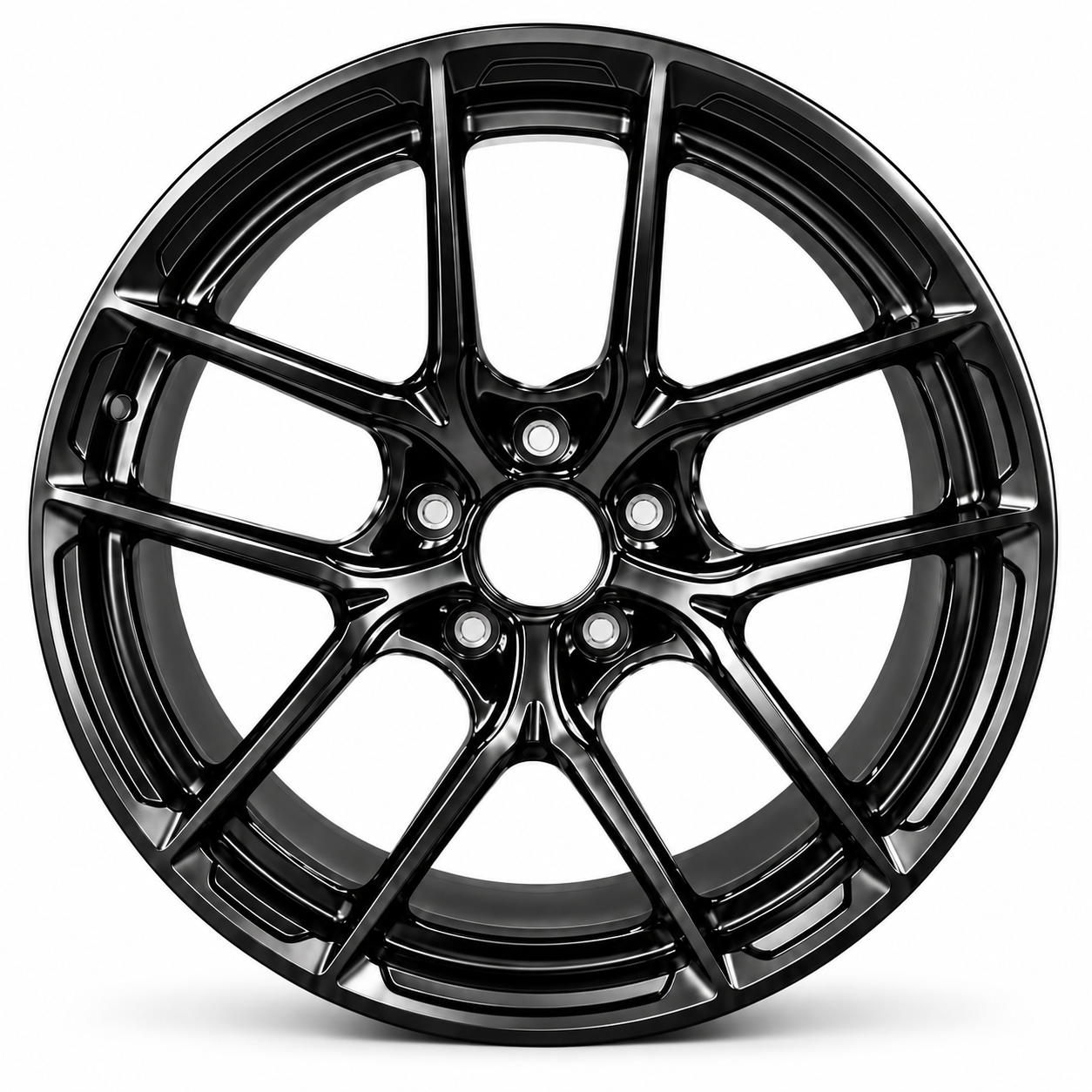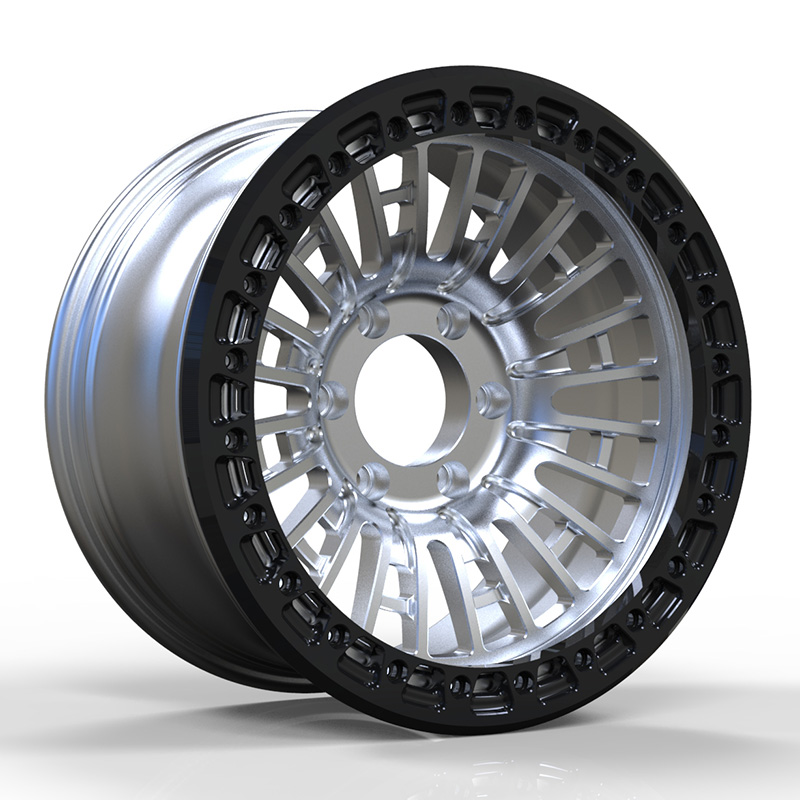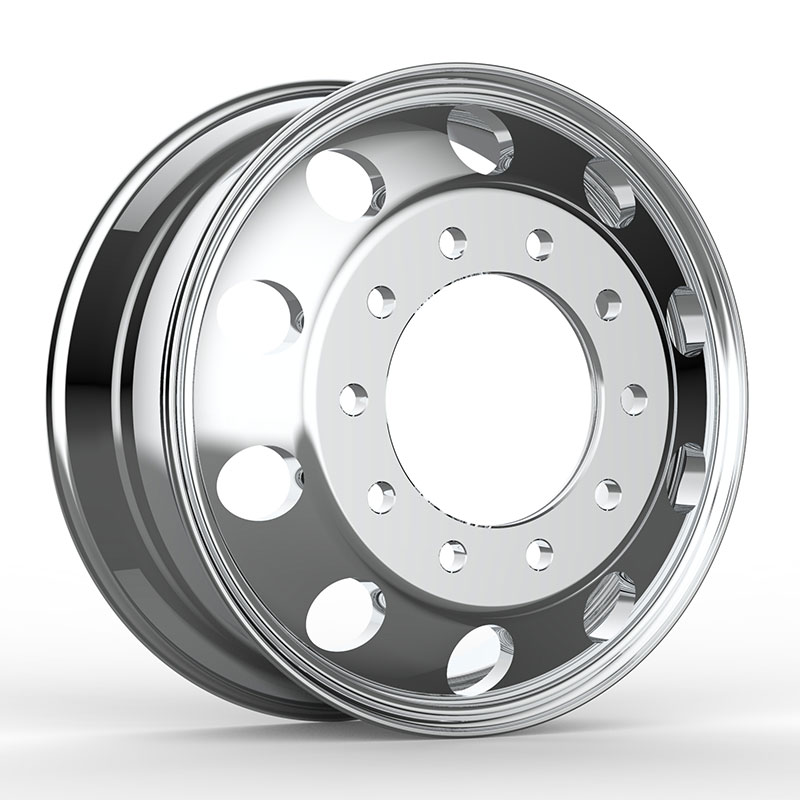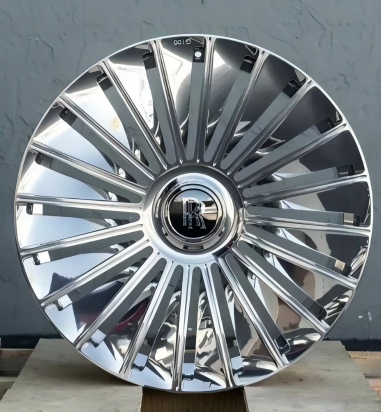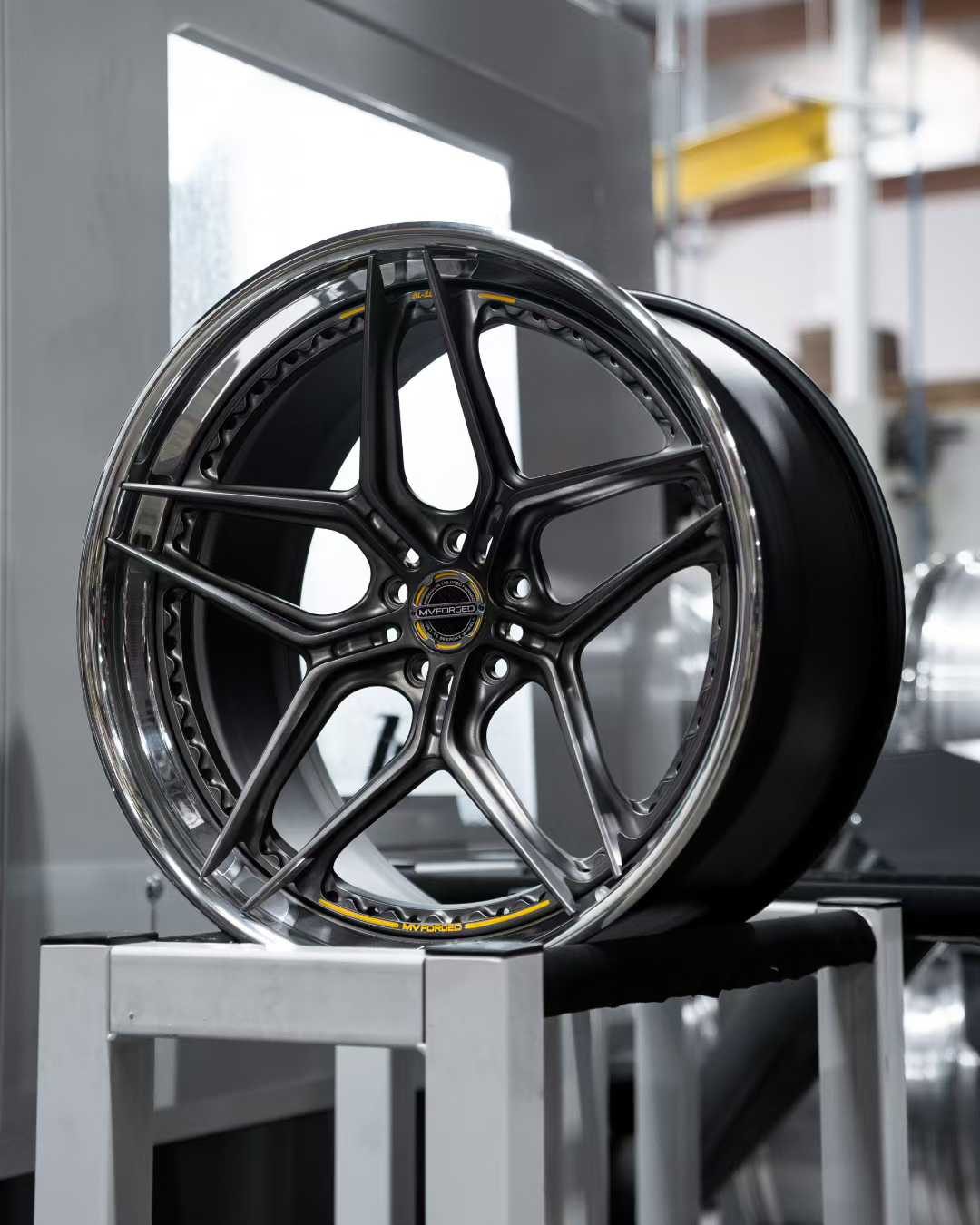
Professional forged concave wheels are engineered around one specific vehicle, not around a shared tool. That single decision explains almost everything a buyer notices later: the concave depth that still clears a six-piston caliper, the backpad thickness that keeps a two-tonne SUV inside its rated load, and the spoke window that leaves enough material to survive a pothole at highway speed. When a wheel is forged from a solid aluminum blank and then machined to a print, the designer is free to move material exactly where the load path runs, and to leave it out where it only adds inertia.
Mass-produced rims work the other way around. A cast or flow-formed program pays for one mould or one flow-forming die, so the same blank has to serve forty vehicle applications with only cosmetic variation. The concave depth ends up limited by the shallowest brake package in that family, and the load rating ends up set by the heaviest application it must not fail. The buyer inherits a wheel that is simultaneously over-built for a sports coupe and marginally rated for a loaded SUV. This article walks through where that gap actually shows up, how a forged concave wheel is made, what a buyer should verify before signing a purchase order, and how to fit the result to a real vehicle rather than to a catalogue photo.
It helps to place the product inside the wider deep concave forged wheels category before going deeper, because "concave" is used loosely in the aftermarket and means three different things depending on who is talking. A wheel with a just-barely-recessed spoke face, a genuinely deep concave monoblock, and a flat-face rim with a decorative lip are all sold as concave by somebody. Knowing which one you are buying, and which one your customer's 911, M3, or GLE actually needs, is the difference between a repeat account and a chargeback.
Why Professional Forged Concave Wheels Start From a Different Point
A cast wheel is made by pouring molten aluminum into a mould. A flow-formed wheel starts as a cast centre and spins the barrel outward under rollers, which improves the rim section but leaves the centre as cast material. A forged wheel starts as a solid billet of 6061-T6 or 7075 aluminum that is heated and pressed under thousands of tonnes of force. That pressing step does not merely shape the metal; it aligns the grain structure with the direction of the load and closes the internal porosity that casting inevitably leaves behind. The result is a material with higher fatigue resistance per kilogram, which is what allows a designer to remove material without removing safety margin.
Concave depth is a geometry problem that only becomes solvable once that material freedom exists. Measured properly, concave depth is the distance from the plane of the outer lip to the deepest point of the spoke face. Pushing that number deeper means the spokes must travel further inward before they reach the hub, which increases the bending moment on every spoke and reduces the space available for the backpad. On a forged wheel the designer answers that by increasing spoke thickness along the load path, tapering the spoke in the region that carries less stress, and moving the hub face inward to recover caliper clearance. On a mass-produced rim there is no such freedom, because the die is fixed.
Monoblock, Two-Piece, and Three-Piece: Where the Professional Tier Splits
Once you are buying forged, the next decision is construction. A monoblock, or one-piece forged wheel, is machined from a single forged blank, which makes it the lightest and stiffest option and the easiest to homologate. A two-piece wheel pairs a forged centre with a separate barrel, joining the two with a bead of structural sealant and a ring of fasteners; this lets a buyer change offset or barrel width without paying for a new centre. A three-piece wheel separates the centre, the outer lip, and the inner barrel, which is the classic route to very deep lips and to repair rather than replace if one section is damaged. Each has a different load path, a different weight penalty, and a different certification story.
| Construction | How It Is Built | Where It Wins | Trade-Off To Accept |
|---|---|---|---|
| One-piece forged (monoblock) | Single forged blank, fully CNC-machined | Lowest weight, highest stiffness, simplest homologation | Offset and width are locked at the time of order |
| Two-piece forged | Forged centre plus separate barrel, sealant and fasteners | Offset and width can be re-specified later | Joint adds weight and needs a torque-check routine |
| Three-piece forged | Centre plus outer lip plus inner barrel | Deepest lips, serviceable in sections | Most assembly labour, most sealing risk |
| Flow-formed (flow forged) | Cast centre, spun barrel | Good value in the mid-market | Centre stays as-cast; concave depth is limited |
The Four Gaps a Mass-Produced Rim Cannot Close
After more than a decade of quoting forged wheel programmes for importers, distributors, and private-label brands, we have watched the same four failures repeat themselves whenever a buyer tries to solve a forged problem with a mass-produced product. They are worth naming honestly, because each one costs a distributor real money in returns, and none of them is visible on a product photo or a specification sheet.
- Caliper clearance collapses as concave deepens. A deep spoke face pushes material inward, and the space between the spoke back and the caliper disappears. Forged tooling can re-profile the spoke without touching the outer appearance; a shared mould cannot.
- Load rating is set by the wrong vehicle. A single blank serving a coupe and a full-size SUV is rated for the SUV, so the coupe buyer pays a weight penalty for margin they will never use, and the SUV buyer still gets a wheel designed around a lighter hub face.
- Offset cannot be corrected at the hub. Vehicle-specific ride height, fender clearance, and spring geometry often demand a backpad dimension that no catalogue wheel offers, which pushes dealers into spacers and the vibration complaints that follow.
- Repair is impossible. A cast or flow-formed wheel that takes a lip impact is scrap. A forged multi-piece wheel can often be re-lipped, which is a service a dealer can bill for instead of absorbing.
A practical rule we give every new distributor: if more than a third of your enquiry list is SUVs, performance sedans, and EVs above 2,000 kg, a single flow-formed programme will not cover the range. Split the line into one forged platform for the heavy end and one for the light end, and stop paying for compromise twice.
How Professional Forged Concave Wheels Are Made, Step by Step
Buyers who understand the process ask better questions, and better questions shorten a development cycle by weeks. The sequence below is the one we run at our own plant in Ningbo, where we have been producing forged aluminum wheels since the RETA brand was established, with a plant of 12,000 square metres and a workforce of more than one hundred. It is also the sequence any serious supplier should be able to describe without hesitating, because a supplier who cannot explain the heat treatment step is not running one.
- Design and fitment study. Vehicle data, brake dimensions, hub bore, PCD, and load target are converted into a 3D model with a defined concave depth and backpad.
- Billet selection and forging. 6061-T6 or 7075 aluminum is heated and pressed so that grain flow follows the spoke and barrel direction rather than running across it.
- Rotary or spin forging of the barrel. The rim section is rolled to width under controlled pressure, which thins the barrel precisely where strength is not required.
- CNC machining. Spoke windows, bolt seats, hub bore, and the concave face are cut on multi-axis machines, with the spoke cross-section tapered along the measured load path.
- Heat treatment and stress relief. T6 ageing restores the hardness lost during forming and stabilises the geometry before final measurement.
- Surface finishing. Hand brushing, polishing, chrome, matte, electroplating, or a two-tone combination, applied according to the buyer's sample approval.
- Testing and inspection. Radial and cornering fatigue, impact, and air-tightness checks, followed by dimensional verification against the approved drawing.
What a forged programme buys you, in one line each:
Stiffer spoke at equal weight — less deflection under cornering load.
Deeper concave without losing brake clearance — the look buyers actually ask for.
Load rating matched to the platform — not inherited from a heavier one.
Serviceable multi-piece construction — a repairable asset, not scrap.
What to Verify Before You Place a Purchase Order
Every serious forged wheel supplier will claim design capability, materials expertise, and in-house testing. The claims are cheap. What separates them is documentation. Request the items in the table below before a deposit leaves your account, and treat a supplier who cannot produce them as a supplier who has not run the process. We hold ISO 9001, ISO 14001, ISO 45001, and IATF 16949 certification, and our internal control testing is deliberately stricter than the published SAE, JWL, and PCT requirements, with additional 30-degree and 90-degree impact and deformation checks on top — that is the level of evidence a buyer should be asking for.
| Item To Request | Why It Matters | Red Flag If Missing |
|---|---|---|
| Material certificate for the billet | Confirms 6061-T6 or 7075 rather than a generic "aluminum alloy" | Supplier answers "high quality aluminum" |
| Fatigue and impact test reports | Shows the wheel was cycled and struck, not just measured | Reports for a different model number |
| Stated load rating per wheel | Lets you match the wheel to the heaviest vehicle in the range | Only a generic "passes standard" claim |
| Brake clearance drawing | Prevents the classic "fits the car, not the caliper" return | No vehicle-specific fitment data at all |
| Approved sample with sign-off | Turns colour and finish into a contract term, not an opinion | Pictures only, no physical sample |
Matching the Wheel to the Vehicle, Not to the Photo
The most common reason a beautifully finished set comes back is not a manufacturing defect; it is a fitment assumption. A wheel that looks perfect on a render can be wrong in three quiet ways. The backpad may be too thick, so the wheel sits proud of the fender and the tyre rubs on compression. The spoke back may be too close to the caliper, so stones collect and the paint blisters. Or the hub bore may be correct but the centre cap protrudes, which is a cosmetic failure the customer notices every single day. None of these show up in a dimension table alone; they show up when the drawing is checked against the actual car.
This is where a smaller, focused range beats a large generic one. Our super concave range exists because the deepest profiles only make sense on vehicles with a narrow brake package and a wide fender, while the one-piece monoblock forged wheels cover the applications where stiffness and weight matter more than lip depth. When a dealer is honest with us about the vehicle list, we usually steer them away from part of it, and that conversation is worth more to both sides than an extra SKU.
A Fitment Checklist We Use With Every New Distributor
Before we release a forged concave programme into production, we ask the buyer to confirm the following. It takes about twenty minutes and it prevents the majority of after-sales disputes we have seen over the years. A wheel programme that clears this list rarely produces a return, and a programme that skips it usually produces three.
- Vehicle and trim level, because brake packages differ inside the same model year and a base car often has smaller calipers than the performance version.
- Suspension state, since a lowered car changes the static camber and therefore the effective fender clearance you are designing to.
- Tyre size and brand, because a nominal 295 section varies in actual width between manufacturers by enough to change the answer.
- Load target, so the wheel is rated for the heaviest configuration the dealer will actually sell, not the lightest one in the catalogue.
- Centre-bore hardware, including whether the buyer wants a flush cap, a protruding cap, or an exposed centre-lock look, as this affects the hub machining step.
- Finish durability expectation, since a coastal or winter market needs a different surface treatment than a show car that never sees road salt.
Building a Private-Label Line Around Forged Concave Wheels
If you are a distributor or a brand rather than a single-car buyer, the economics change. You are no longer buying a wheel; you are buying a repeatable design language that your customers will recognise across a range. That means the concave depth has to be consistent from a 19-inch entry fitment to a 22-inch flagship, the spoke proportions have to look right at every diameter, and the finish has to survive a season in your market. It also means the first sample matters more than the first shipment, because a design flaw caught at sample stage costs a revision, while the same flaw caught at container stage costs a recall.
We handle this through a wheel customization programme that separates the design freeze from the colour freeze, so a buyer can approve the geometry once and then add finishes over time without re-tooling. It is a small structural decision that saves a surprising amount of money in the second and third seasons, which is exactly when most new wheel brands discover whether their supplier was actually a manufacturing partner. If you want to see how a finished design reads in metal rather than in a render, the golden Y-spoke concave forged wheel in our library is a good reference for how much depth a clean five-axis cut can carry without looking fragile.
Specification Mistakes That Cost Distributors Money
The same handful of errors appear in almost every first-time forged concave programme we audit. The most expensive is specifying by diameter alone. A dealer orders "twenty-inch concave," approves a photograph, and only discovers at container stage that the concave depth in that fitment is shallower than the picture, because the deepest profile was only available in a different width. The second is treating offset as a styling variable rather than a mechanical one; moving the wheel outward to fill the arch changes the scrub radius and the load path through the hub, which is felt as tramlining on a motorway and as accelerated bearing wear two seasons later. Neither mistake is a manufacturing defect, and neither is something a supplier can correct once the wheels have been cut.
The third is under-specifying the finish for the market. A polished or chrome outer lip is a strong seller in a dry inland region and a liability in a coastal city or a country that salts its roads; within eighteen months the lip shows corrosion, and the dealer blames the wheel rather than the specification. The fourth, and the one we push back on hardest, is skipping the physical sample. A twenty-minute inspection of a real wheel on a real hub face catches machining burrs, cap fit, valve clearance, and colour drift that no render will ever reveal. Buy a sample set, mount it, photograph it, and only then release the volume order.
FAQ: Professional Forged Concave Wheels
These are the questions that reach our engineering inbox most often from importers, wheel dealers, and brand owners who are specifying forged concave wheels for the first time.
Q1. How deep can a concave forged wheel go before it becomes unsafe?
There is no single number, because the limit is set by vehicle geometry and spoke design rather than by depth alone. What matters is that the spoke cross-section still carries the bending load and that the backpad keeps adequate brake clearance. A well-designed deep concave wheel is not weaker than a shallow one; it simply moves material to a different place along the spoke.
Q2. What is the minimum order quantity for a forged concave wheel programme?
Our standing policy is one set, which is four wheels, so a buyer can validate fitment before committing to volume. Standard configurations move through production in roughly seven to fifteen working days, while a fully custom design, including new tooling and finish development, typically runs twenty-five to thirty-five working days.
Q3. Which standards should a forged concave wheel comply with?
The relevant references in this industry are SAE J2530, JWL and JWL VIA, TUV, DOT, and ECE R124, depending on the destination market. In practice, a credible manufacturer tests beyond the minimum, and we run additional thirty-degree and ninety-degree impact and deformation checks on top of our normal control plan. Ask for the report, not the logo.
Q4. Is a one-piece forged concave wheel better than a three-piece one?
Better is the wrong word; they solve different problems. A one-piece wheel is lighter, stiffer, and simpler to certify, which suits track-oriented and performance applications. A three-piece wheel offers deeper lips, re-specifiable widths, and section-level repair, which suits a dealer who wants to service a wheel instead of replacing it. Most serious ranges carry both.
Q5. Can forged concave wheels be made for electric vehicles?
Yes, and they suit EVs particularly well. Battery weight raises the load target, and a forged wheel meets that target without the mass penalty a cast wheel would carry. The design must also account for the higher torque loads at the hub and for the reduced noise masking on an electric drivetrain, which makes a well-machined, balanced wheel easier to appreciate from the driver's seat.
Where to Go From Here
If you are evaluating a forged concave programme, the fastest way to reduce your risk is to stop comparing catalogue photographs and start comparing drawings. Send us the vehicle list, the load target, and one reference finish, and we will come back with a fitment study, a construction recommendation, and an honest answer about which of your target applications do not need a forged wheel at all. That last part is not a sales technique; it is how a manufacturing relationship survives its third season. You can read more about how our plant in Ningbo operates on the about RETA page.
RETA is a forged wheel manufacturer in Ningbo, China, running rotary forging, CNC machining, and surface finishing under one roof, serving OEM, ODM, and private-label buyers across more than a decade of export work, with 7075 forged aluminum in volume production and IATF 16949 process control behind it. If your programme needs wheels that fit the car in front of you rather than the average of forty others, that is exactly the problem professional forged concave wheels are built to solve.